Martin Žemla delivered a talk at the Stavelot VERITRACE internal workshop in early February, sharing his insights on “The Taste and Beauty of Wisdom: Sensory Metaphors (Not Only) in the Renaissance.” The event fostered lively discussions in a warm and stimulating setting, blending scholarship with the unique atmosphere of a quasi-monastic surroundings—an experience Martin thoroughly enjoyed.
Lucie Storchová gave a talk titled “Reconstructing the Hassenstein Library: Identity and Memory Politics of Prague Humanists in 1570“ at the 71st Annual Meeting of the Renaissance Society of America Conference (2025) in Boston, Massachusetts. In addition to her presentation, she also chaired the panel “Libraries and Early Modern Education Across Europe,” contributing to the rich scholarly discussions at the event.
The Computational-Historical Group—Vojtěch Kaše, Jan Tvrz, and Jana Švadlenková—has released two innovative web applications:
iWEEMS: Interactive Word Embeddings for Early Modern Science
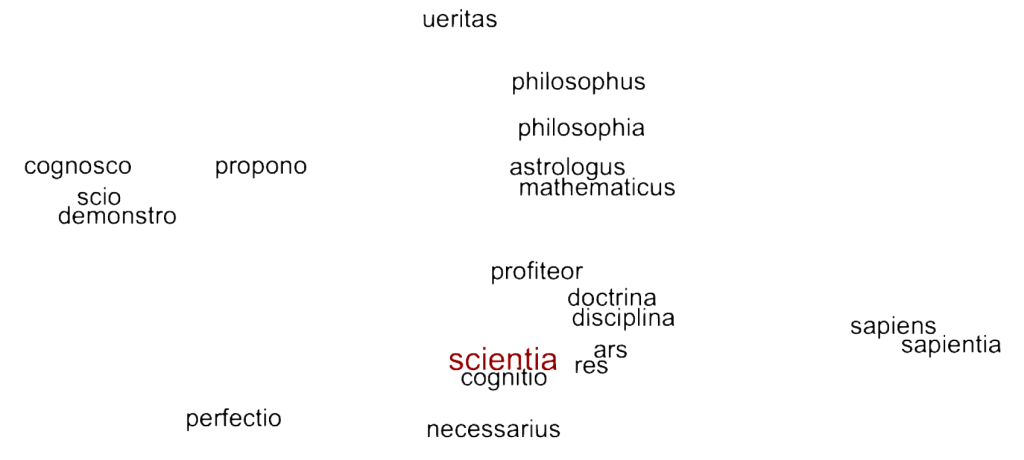
This tool provides interactive visualizations of the word embedding models trained on early modern scientific prints in Latin (WEEMS), using data from the NOSCEMUS Digital Sourcebook. What is more, the NOSCEMUS word embeddings are now easily comparable with LASLA embeddings, Aquinas’ Opera maiora embeddings. We expect that EMLAP word embeddings will be added to the app in a near future.
AMeD: Automatic Metaphor Detection
Based on the MelBERT model, this app utilizes sub-word contextual vector representations from BERT to compare the sentence-specific usage of a word against its decontextualized representation, enabling solidly powerful metaphor detection.
Both applications offer valuable resources for researchers exploring (synchronically and/or diachronically) the historical scientific, scholarly and literary texts, conceptual/metaphorical history, and historical semantics.
New dataset was published:
Hedesan, G., Huber, A., Kodetová, J., Kříž, O., Kubíčková, J., Kaše, V., & Pavlas, P. (2025). EMLAP (v0.4). Zenodo. See the dataset here.
Three new publications of the TOME’s research team members, although institutionally created outside TOME within different projects, are still thematically very interesting for TOMEists:
Nannini, Alessandro (2024). Clinical aesthetics. Johann Christian Bolten and the aesthetic origins of psychotherapy. Intellectual History Review, 35(1), pp. 105–127. https://doi.org/10.1080/17496977.2024.2437193
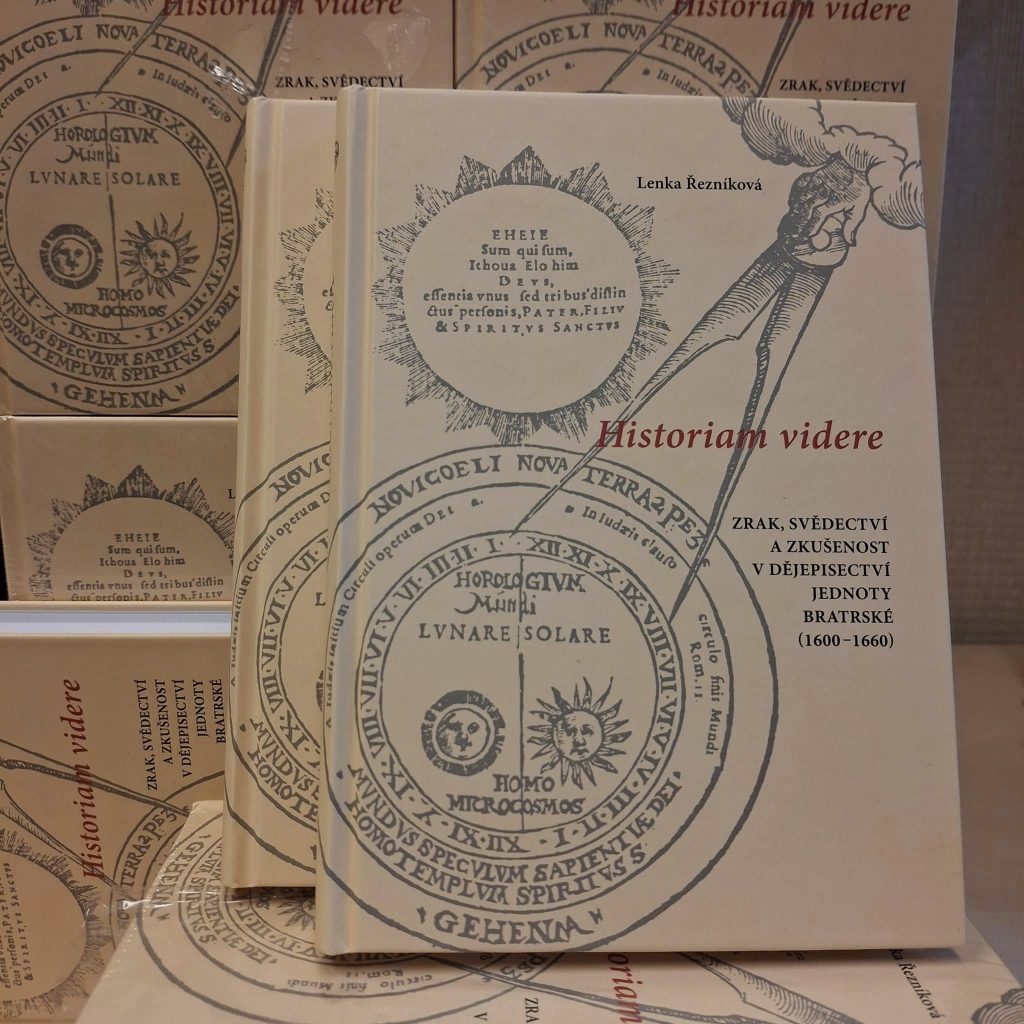
Řezníková, Lenka (2024). Historiam videre: Zrak, svědectví a zkušenost v dějepisectví Jednoty bratrské (1600–1660) [Historiam videre: Sight, Testimony, and Experience in the Historiography of the Unity of the Brethren (1600–1660)]. Praha: Skriptorium. 264 pp.
Szentpéteri, Márton (2024). Fruitful Ambiguities of Artistic Research. In: Szentpéteri, Márton (ed.), Varietas delectat: Research Cultures in Art and Design. 25th Anniversary of the Doctoral School.Budapest: Moholy-Nagy Művészeti Egyetem (MOME), pp. 124-141.
Lucie Storchová will participate in the 19th International Congressof the International Association for Neo-Latin Studies (IANLS), organized by the IANLS and Aix-Marseille University. The congress will take place from 14 to 20 July 2025 in Aix-en-Provence, France. Lucie will present a poster on “The Origins of Modern Encyclopaedism (TOME): Launching Evolutionary Metaphorology” and also deliver a talk on “Metaphors of Scholarly Love and Cooperation in 17th-Century Learned Correspondence.” Additionally, she will chair the section “Companion to Neo-Latin in Hungary II.” For more details, see the event website.
Lenka Řezníková will actively attend the 13th COMENIUS Conference, which aims to explore the dynamic interplay between theology, philosophy of religion, and their historical and contemporary contexts. The conference takes place from 14 to 17 May 2025 at the Protestant Theological Institute in Cluj (Kolozsvár), Romania. See here for more info on the event.
At the invitation of Farzad Mahootian and Justin Stearns (New York University Abu Dhabí), Petr Pavlas and Vojtěch Kaše will deliver a joint keynote lunch address at a workshop in Abu Dhabi, taking place from 14 to 17 May 2025. Other keynote speakers include Guillermo Restrepo (Max Planck Institute for Mathematics in the Sciences, Leipzig) and Sarah Lang, Head of Digital Humanities at the Max Planck Institute for the History of Science in Berlin.
Georgiana Hedesan is organising a roundtable at the 14th International Conference on the History of Chemistry (“Chemistry and Capitalism”). Titled “New Computational and Experimental Methods in the History of Alchemy and Chemistry,” the discussion will feature a distinguished panel, including: Petr Pavlas, Guillermo Restrepo (Max Planck Institute for Mathematics in the Sciences in Leipzig), Farzad Mahootian (NYU New York), Carmen Schmechel (Royal Netherlands Academy of Arts and Sciences), Thijs Hagendijk (Utrecht University), Peter Oakley (Royal College of Art). Find more info here.
Leave a Reply